
- Company name
- Toyota Motor Corporation
- Address
- 1 Toyota-Cho, Toyota City, Aichi Prefecture
- URL
- https://global.toyota/en/
- Industry
- Motor vehicle production and sales
- Number of employees
- Over 70,000
- Customer issues
- Interview Movie
- History behind the development
- Effect of introduction
- Future development and prospects
- Staff messages
Customer issues
Die-cast molds accumulate damage through repeated use, making quantitative maintenance essential. However, managing the repair history with traditional handwritten records, made it difficult to quickly access the necessary information, making it hard to utilize it for preventive maintenance before failures occur. Customer/User wanted to promote DX to improve maintenance efficiency and maximizing data utilization.
Effects of implementation
By introducing “3D KATADASU” mold defect information that was previously managed on paper was digitized. Staff can now check 3D models on smartphones, significantly speeding up their tasks. Real-time data sharing became possible, enhancing the accuracy of preventive maintenance before failures. The system also helped overcome issues in skill transfer, contributing to a reduction in training burdens.
Interview Movie
History behind the development
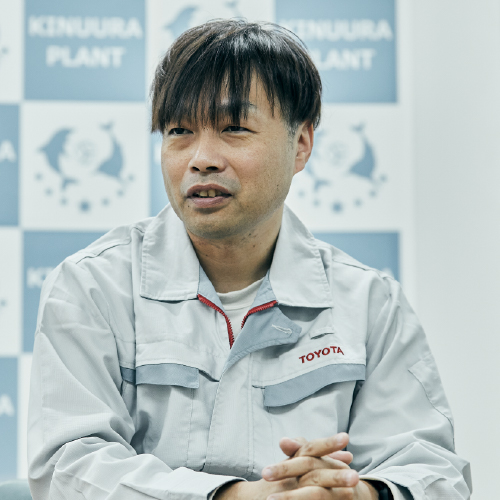
Power, Die Casting & Forging Equipment Maintenance Section
Kinuura Plant Die Casting & Forging Div.
Group Leader
Akira Takasugi
To solve the issues of defect management using paper, we introduced the “3D KATADASU” system that allows defects to be recorded directly on 3D models.
We used to manage defect information for die-cast molds by writing on paper and then transfered them to 2D Excel files. This process was time-consuming and the information was not updated in real time. In addition, certain areas were difficult to capture accurately in 2D, so we added more descriptions like "the rear side of this surface". Even though experienced staff could interpret these notes to some extent, younger or less experienced staff could not understand it well.
When implementing DX, we focused not only on accurately recording information but also on making the system easy to understand, simple, and intuitive to operate. Since many staff are unfamiliar with digital tools, it was important that the system be user-friendly and intuitive for everyone.
We collaborated with Toyota Systems, gathering feedback from on-site and continuosly refining the specifications with a strong focus on usability.
Effect of introduction
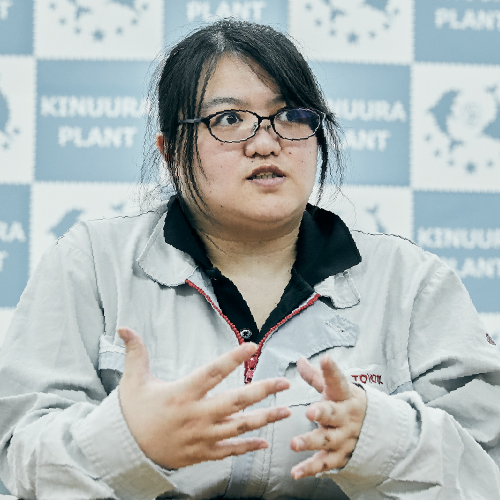
Die Maintenance Section
Kinuura Plant Die Casting & Forging Div.
Yayoi Tateda
In addition to improving the speed of the work, the burden of the tabulation work was also eased. It is also contributing to the smoother passing on of skills.
After introducing “3D KATADASU,” we became able to link and register maintenance information to part on 3D model, which greatly improved work efficiency. Being able to check the 3D model from anywhere using smartphones or other devices allowed us to complete tasks on the spot. Many staff commented that "We can now check the mold shapes via the web from anywhere, which has increased work efficiency."
There were also major progress in information management and sharing. By digitizing repair records that were previously managed manually, we greatly reduced the time required for data aggregation. Furthermore, since the necessary information can now be viewed in real time, maintenance before failures can be performed more accurately. As a result, this has led to improved productivity and time savings, enhancing the overall efficiency of the site.
Moreoever, we believe that closer information sharing between design team and on-site staff has contributed to improved quality.
With traditional 2D management, experienced staff could understand the information, but it was often difficult for younger or less experienced staff to grasp, making skill transfer a major issue. However, these problems were resolved with the introduction of “3D KATADASU.” The benefits have exceeded our expectations in many ways, and we plan to continue using it while further evolving and improving the system moving forward.
Future development and outlook
This has become a very meaningful case that holds great potential for future developments. We have great expectations for the future.
We believe that if this technology is widely adopted at other plants in the future, it will lead to improved productivity across many more sites. Furthermore, with the 3D KATADASU technology, we expect its applications can extend beyond mold maintenance to equipment management and other areas as well.
Achieving this would not be possible without the support of Toyota Systems. This time as well, they consistently approached things from the perspective of on-site and collaborated with us to create solutions that are user-friendly for many people.
Going forward, we want to make the system even more user-friendly for a wider range of staff by enhancing language options and accessibility functiond. Another goal is to utilize it as a parameter for CAE analysis to further improve the simulation accuracy.
We very much hope that Toyota Systems will continue to be a key supporter of the entire manufacturing industry as a member of the Toyota Group.
Message from our developers
Some staff are not familiar with using smartphones, so our top priority was ensuring ease of use. In particular, although it was demanded that the handling of the 3D data could be operated intuitively, there were issues with the operational load and complexity. We already specialized in development utilizing XVL, a lightweight 3D format, but in order to overcome the issues for this project, we carefully gathered feedback from the field and proceeded with iterative improvements through trial and error. We feel extremely proud that the system we completed through this process is now actually being utilized and creating value in Toyota manufacturing sites.
In order for us to provide various systems to further advance the manufacturing industries of Japan, it will be essential that we continue to take a wide perspective and think flexibly. In addition, each factory has a different culture and its own operations, so instead of forcing a uniform solution on them, We believe that it is important to introduce and operate the systems that tailored to each site. Going forward, we will continue to sincerely listening to the opinions from the field and provide systems that contribute to productivity improvement with even higher accuracy.
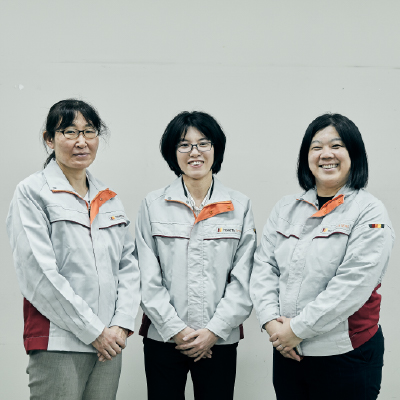
From left in the photo:
Toyota Systems Corporation
Production Engineering and Manufacturing Process Innovation Division
Digital Utilization Promotion Group 1
Group Manager
Mika Yoda
Production Engineering and Manufacturing Process Innovation Division
Digital Utilization Promotion Group 1
Shizuka Kawade
Production Engineering and Manufacturing Process Innovation Division
Product Planning Group
Group Manager
Michiko Sasaki