
- Company name
- Toyota Motor Corporation
- Address
- 1 Toyota-Cho, Toyota City, Aichi Prefecture
- URL
- https://global.toyota/en/
- Industry
- Motor vehicle production and sales
- Number of employees
- Over 70,000
- Customer issues
- Interview Movie
- History behind the development
- Effect of introduction
- Future development and prospects
- Staff messages
Customer issues
There is a vast amount of information required for equipment maintenance work, including electronic drawings, mechanical drawings, specification documents and more. Most of this information is managed on paper. Searching for the necessary information takes considerate time, forcing maintenance staff to engage in "non-value-added tasks." Since rapid recovery is essential when equipment breaks down unexpectedly, we have considered digitization to enable smoother maintenance operations.
Effects of implementation
We developed the “Factory Explorer” an application that allows users to search and view not only drawing information but also equipment status and maintenance history from other systems, all on a tablet. Various documents are linked to maps of the plant premises, enabling users to narrow down information by selecting the target production line.
Various systems can be accessed on the tablet, allowing replacement parts to be arranged and coordination with the relevant parties to be carried out on-site without returning to the team member room.
Additionally, by utilizing point cloud data, risks related with high-altitude work can be identified in advance, thereby enhancing safety measures before the tasks begin.
Interview Movie
History behind the development
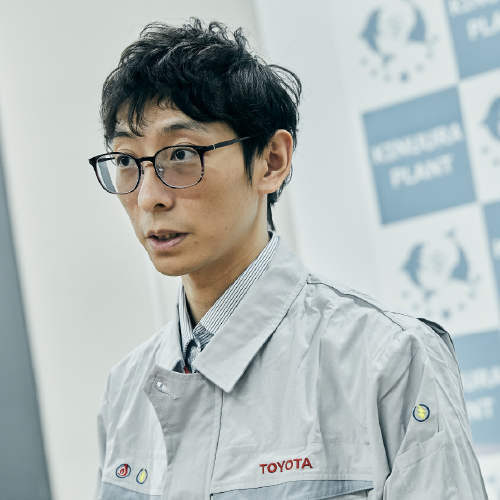
Plant Support Dept.
Drivetrain Hybrid & Electric Vehicle Powertrain Manufacturing Engineering Div.
Kinuura Plant, Production Group
Expert
Yuya Mizokami
We developed a system that balances quick searches with ease of use, helping to reduce the burden on maintenance staff.
When equipment breaks down, production stops, causing delays in the subsequent processes, and ultimately making our customers wait for their cars. To complete repairs as quickly as possible, digitalization was one of the solutions we considered.
The biggest issue in digitization was the “search speed.” Simply digitizing the documents alone wouldn’t solve the problem fundamentally. It was necessary not only to eliminate the "wasted time" spent walking to the archives to retrieve materials but also to quickly locate the needed information from the vast amount of paper documents. In addition to the “search speed,” we needed the system to be intuitive and easy to use, even for staff who were not familiar with digital tools. That’s how the development began.
I experienced this myself, the first job for a new employee assigned to equipment maintenance was "to fetch documents from the storage as instructed by senior colleagues." During that time, those seniors would move on to other investigations or repairs. I felt that missing out on observing the work process up close was a significant loss of a learning opportunity.
Effect of introduction
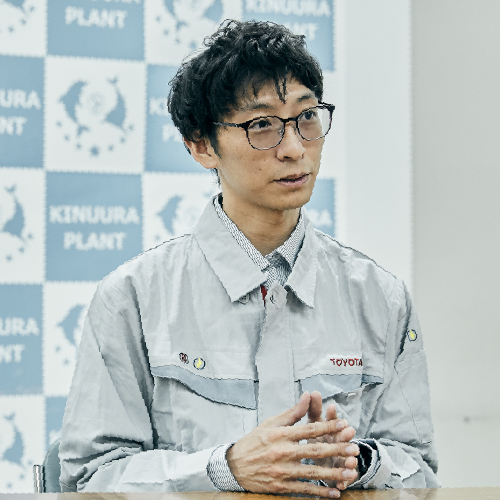
Work efficiency has improved dramatically. We were able to reduce MTTR(Mean Time to Repair) by 10 to 15 minutes.
For the major issue of the search speed, we took inspiration from the hashtag searches on social media and came up with the idea of tagging drawings and specifications with hashtags to quickly access the necessary information. However, when we actually implemented this, the search scope was too broad, and it took much longer than expected to retrieve the relevant items. When we consulted with developers from Toyota Systems about shortening the search time, they actually came to the factory to observe the usage scenarios. It was very encouraging to have them see the maintenance site, where every second counts to restore equipment as quickly as possible, and then improve the search logic to better suit the needs of the field.
Not only has the search time for information been significantly reduced, but it has also become the standard practice to use the camera function on tablets to keep records and videos of the work. This has helped us accumulate and share valuable know-how related to maintenance works. We believe this has also increased opportunities for new staff to learn by watching their more experienced colleagues at work.
After introducing the "Factory Explorer," we were able to reduce MTTR(Mean Time to Repair) by 10 to 15 minutes. When we needed to migrate the server to support the new production line, we completed the transition smoothly thanks to the clear instructions and the new server URL provided on the trial environment page, and there was no confusion in the production site.
Future development and outlook
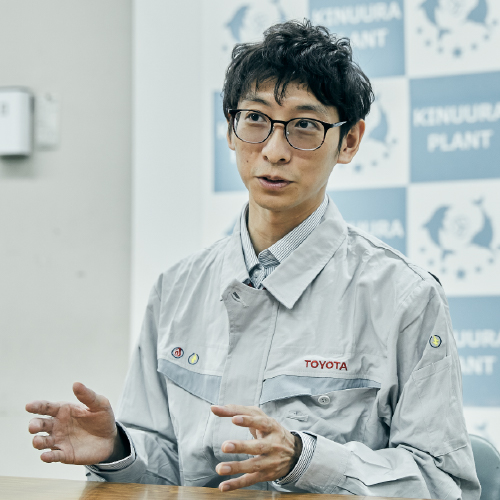
We have achieved greater efficiency in equipment maintenance operations and strengthened our safety measures. We also look forward to further advancements and developments in the future.
With the introduction of the “Factory Explorer,” which links documents and maps and also includes a point cloud viewer, we are now able to unify data management required for equipment maintenance in one place. Being able to check equipment status, arrange replacement parts, and enter maintenance records directly from a tablet has significantly improved our efficiency
In equipment maintenance, we often have to work in high places or tight spaces, so implementing safety measures beforehand is absolutely essential. By utilizing point cloud data to gain a clear understanding of the surrounding area before starting work, we have been able to carry out maintenance more safely and smoothly.
When we introduced the system, Toyota Systems didn’t just listen to our initial requirements, they also took feedback from the people working on the ground and made continuous kaizen. As a result, even our veteran staff who weren’t very familiar with digital tools have been giving us a lot of positive feedback, saying it’s easy to use and has made their work much easier.
I am sure that these digital technologies will continue to evolve even further in the future. I’m counting on Toyota System to keep improving the accuracy of the point cloud data and expanding the system’s capabilities, so they can provide us with an even more comfortable and efficient environment.
Message from our developers
The starting point for the Factory Explorer development was to “address concerns” raised at the operation site. We conducted numerous interviews with maintenance staff to understand their workflows and the features they needed. Visiting the actual sites where the system would be used and hearing feedback directly from users reinforced for us just how important “Genchi Genbutsu", (going to the site and seeing the real thing), is in system development.
Previously, they used to enlarge original paper drawings using a copier and brought them to the site, but this often caused fine wiring details and numbers to blur, making them hard to read. Now, with electronic drawings accessible on tablets, we can zoom in on the necessary parts and see everything clearly. We have even received direct praise from users saying, “This has made things so much easier.”
The development team faced challenging issues, such as how to display heavy point cloud data, and how to implement hashtag search functionalities, but they worked through these issues with trial and error and responded promptly. Moreover, many team members have supported us not only during system development but also with maintenance and support after the release. I am very grateful to all the members who have been involved
Moving forward, I want to continue listening to users’ honest feedback and develop features that truly address the real issues faced at the operational site.
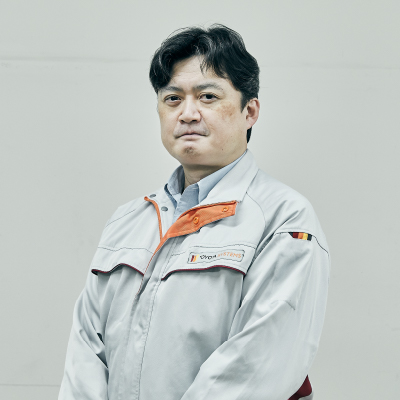
Digital Twin Utilization Division
Utilization Group 3
Group Manager
Takao Minakuchi